
A disciplined approach to self-storage investing starts with the right operator.
Successful real estate investing begins with two questions: are we partnering with the right operator, and does the investment make sense on its own merits?
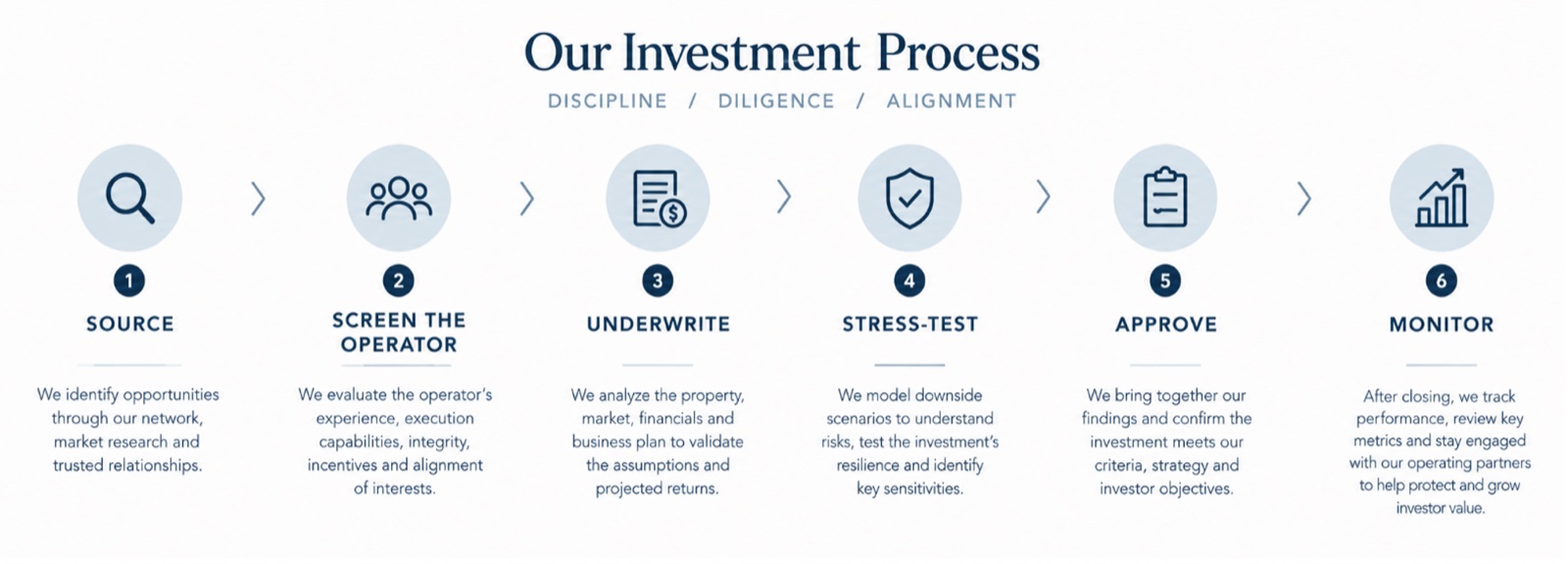
We invest in self-storage alongside experienced operating partners. Our role is to evaluate the people, the opportunity and the underlying economics before committing capital, and to stay actively involved after closing.
We combine operator-level diligence, independent underwriting, downside analysis and ongoing monitoring, so our investors can make informed decisions about what to invest in. The process is designed to be selective, transparent and aligned with our investors' long-term interests.
Sourcing and screening opportunities
We start with relationships, not just real estate.
Not every attractive-looking property is an attractive investment. We evaluate the operating partner, the strategy and the opportunity itself before advancing to a deeper review. We typically review at least 50 opportunities a year but invest in only 2 or 3 of them.
Our initial screening considers:
- Strategic fit: does the opportunity align with our investment focus and criteria?
- Market fundamentals: local supply and demand, the competitive landscape, population and employment trends, and barriers to new development.
- Business plan: is the strategy clearly defined and supported by evidence? We typically acquire value-add properties with clear improvements we can make.
- Capital requirements: are the proposed equity, debt, reserves and future funding needs right for the plan?
- Initial risk assessment: what are the principal risks, and are they identifiable and manageable?
Attractive projected returns alone are never a reason for us to consider an investment.
Evaluating the operating partner
The operator matters as much as the asset.
Self-storage is an operating business as well as a real estate investment. Results depend on the quality of the operator, its execution, its systems, and its ability to respond when market conditions change. We work with only a handful of carefully selected operators.
We evaluate the people responsible for executing the business plan:
- Relevant experience: track record with comparable assets, markets and strategies.
- Execution capability: leasing, pricing, marketing, customer service, staffing, maintenance and capital improvements.
- Financial discipline: budgeting, expense management, reporting, liquidity, and managing through periods of underperformance.
- Integrity and transparency: willingness to give clear information, answer difficult questions, disclose conflicts and communicate setbacks.
- Alignment of interests: the operator's own capital and economic exposure relative to our investors'.
- References and background: professional history, prior investment performance, references and available background information.
We look beyond projections to understand how an operator has performed in different market conditions, what drove prior results, and how it handled challenges. Our objective is partners whose experience, judgment and incentives support the successful execution of a business plan.
Underwriting the investment
We examine the assumptions behind the returns.
If we are interested, we conduct a detailed review of the property's financial performance, market position, capital structure and projected operating results.
Property and market analysis
- Historical operating statements and occupancy trends.
- In-place rents, achievable rents, unit mix and competitive pricing.
- Local supply pipeline, competing facilities and market demand.
- Property condition, deferred maintenance, capital expenditures and other physical considerations.
Financial analysis
- Revenue, occupancy, rental-rate growth and concessions.
- Operating expenses, property management costs, taxes, insurance and maintenance.
- Acquisition and capital expenditure costs, financing terms, capital reserves and anticipated additional funding.
- Projected cash flow, debt-service requirements, and the assumptions behind the expected exit value.
- Fees, promote or carried-interest arrangements, and how cash flow and proceeds are shared among the parties.
We assess whether the assumptions are supported by evidence and whether investors are adequately compensated for the risks they take. The investment must also support the quarterly distributions we typically require for our investors.
Testing the downside
A sound investment case must withstand more than one scenario.
We don't judge an opportunity on its base case alone. We consider how it could perform if the business plan takes longer, costs more, or brings in less revenue than expected. Depending on the investment, we look at:
- Slower lease-up or occupancy growth: what if customer acquisition takes longer than projected?
- Lower rental rates: how resilient is revenue if competition limits pricing power?
- Higher expenses: what if property taxes, insurance, payroll, maintenance or utilities exceed budget?
- Construction and capital-cost overruns: what if costs rise or completion is delayed?
- Financing pressure: how sensitive is the investment to interest rates, refinancing terms, debt maturities and lender requirements?
- Lower exit valuations: what if capitalization rates rise or the eventual sale price is below expectations?
- Additional capital needs: could the property need more equity, and what would that mean for existing investors?
We weigh the impact of these scenarios on cash flow, liquidity, debt obligations and required reserves. The aim is not to predict every outcome. It is to understand the investment's vulnerabilities, find the assumptions that matter most, and decide whether the risks are reasonable relative to the potential reward.
Investment approval and closing
Capital is committed only after the key questions have been addressed.
Before moving forward, we bring together our findings on the operator, property, market, financial projections, capital structure and principal risks. We confirm that:
- The operator has the capability and resources to execute the plan.
- The underwriting is supported by reasonable, documented assumptions.
- The financing and capital structure are appropriate for the investment.
- The downside scenarios are understood and acceptable.
- The economics and governance arrangements are clearly defined.
- The investment aligns with our strategy and the interests of our investors.
We work with legal, property, environmental, financing and other third-party professionals on specialized diligence. Closing is not the end of the process: it is where the operating plan and ongoing oversight begin. See case studies of properties we currently own.
Monitoring investments after closing
Our involvement continues beyond the initial investment decision.
Once an investment closes, we monitor performance against the business plan. Our monthly oversight typically covers:
- Operating performance: occupancy, rental rates, revenue, expenses and net operating income.
- Budget and business-plan progress: actual results against projections, and why they differ.
- Capital and liquidity: debt obligations, reserve levels, capital expenditures and potential funding needs.
- Market developments: competitive supply, pricing conditions and changes in local demand.
- Operator communication: regular contact with operating partners and property managers about results, challenges and corrective actions.
- Investor reporting: at least quarterly, covering material performance developments, key risks and relevant financial information.
When performance deviates from expectations, we work out why, assess the implications, and work with the operating partner on the right response. Real estate is dynamic, and no diligence process eliminates investment risk. Ongoing monitoring helps us spot issues, ask better questions and make better-informed decisions as circumstances change.
How we and our operating partners work together
Distinct responsibilities. A shared focus on investment performance.
Scaffold Partners
Investment selection, diligence, underwriting, capital allocation and oversight. We evaluate the operator and the opportunity, scrutinize the financial assumptions, assess downside risks, review investment structures and monitor performance after closing. We also keep investors informed about the process, economics and material developments, in line with each investment's documents.
Our operating partners
Executing the property-level business plan. Depending on the investment, that may include the acquisition, property management, leasing and pricing, marketing, customer service, staffing, maintenance, capital improvements and day-to-day operating decisions.
Together
We pair disciplined investment evaluation and oversight with operators who have the experience to execute the plan, and allocate responsibilities under each investment's governing documents. Our role is not to replace capable property-level management. It is to add a layer of investment evaluation and oversight to the opportunities and partners we choose.
Investors deserve more than an attractive projection. They deserve a thoughtful process for evaluating the people managing their capital, the assumptions behind the investment, the risks that could affect results, and the plan for monitoring performance over time. That is the discipline we bring to every opportunity we pursue.
Want to learn more about our approach? Watch Self-Storage Investing 101 or contact us to talk about our investment philosophy and process.
Join our investor network
Be the first to hear about new self-storage opportunities, with the full due diligence behind each one.
Prefer to talk first? Call (860) 748-5936 or email jgreshin@scaffoldpartners.com